Press
What is uranium enrichment and how quickly could Iran build a nuclear bomb?
Images
1 / 12
2 / 12

3 / 12

4 / 12

5 / 12

6 / 12

7 / 12

8 / 12

9 / 12

10 / 12

11 / 12

12 / 12
Al Jazeera spoke with MIT professor Ted Postol about what Iran could do with its 440kg of 60 percent enriched uranium.

Save

Share

United States President Donald Trump has claimed that a new nuclear deal being negotiated with Iran will be “far better” than the 2015 Joint Comprehensive Plan of Action (JCPOA), which the US withdrew from in 2018 during his first term.

On Tuesday, Trump extended the two-week ceasefire with Iran a day before it was set to expire, with hopes for a second round of talks in Islamabad, Pakistan.

Key among the US demands is that Iran stop all enrichment of uranium.

Iran has always insisted its nuclear programme is for civilian use only, such as for power generation, which requires uranium enrichment of between 3 percent and 5 percent. To build nuclear weapons, uranium needs to be enriched to 90 percent.

In this explainer, we visualise what uranium is, how it is enriched and how long it could take Iran to make a nuclear weapon.

Uranium is a dense metal used as a fuel in nuclear reactors and weapons. It is naturally radioactive and usually found in low concentrations in rocks, soil and even seawater. About 90 percent of the world’s uranium is produced in just five countries: Kazakhstan, Canada, Namibia, Australia and Uzbekistan. Reserves of uranium have also been found in other countries.

Uranium is extracted either by digging it out of the ground or, more commonly, through a chemical process that dissolves uranium from within the rock.

Before it can be used as nuclear fuel, uranium is processed through several different forms, including:

Natural uranium exists in three forms, called isotopes. They are the same element, with the same number of protons but different numbers of neutrons.

Most naturally occurring uranium (99.3 percent) is U-238 – the heaviest and least radioactive – while about 0.7 percent is U-235 and trace amounts (0.005 percent) are U-234.

To generate energy, scientists separate the lighter, more radioactive U-235 from the slightly heavier U-238 in a process called uranium enrichment. U-235 can sustain a nuclear chain reaction while U-238 cannot.

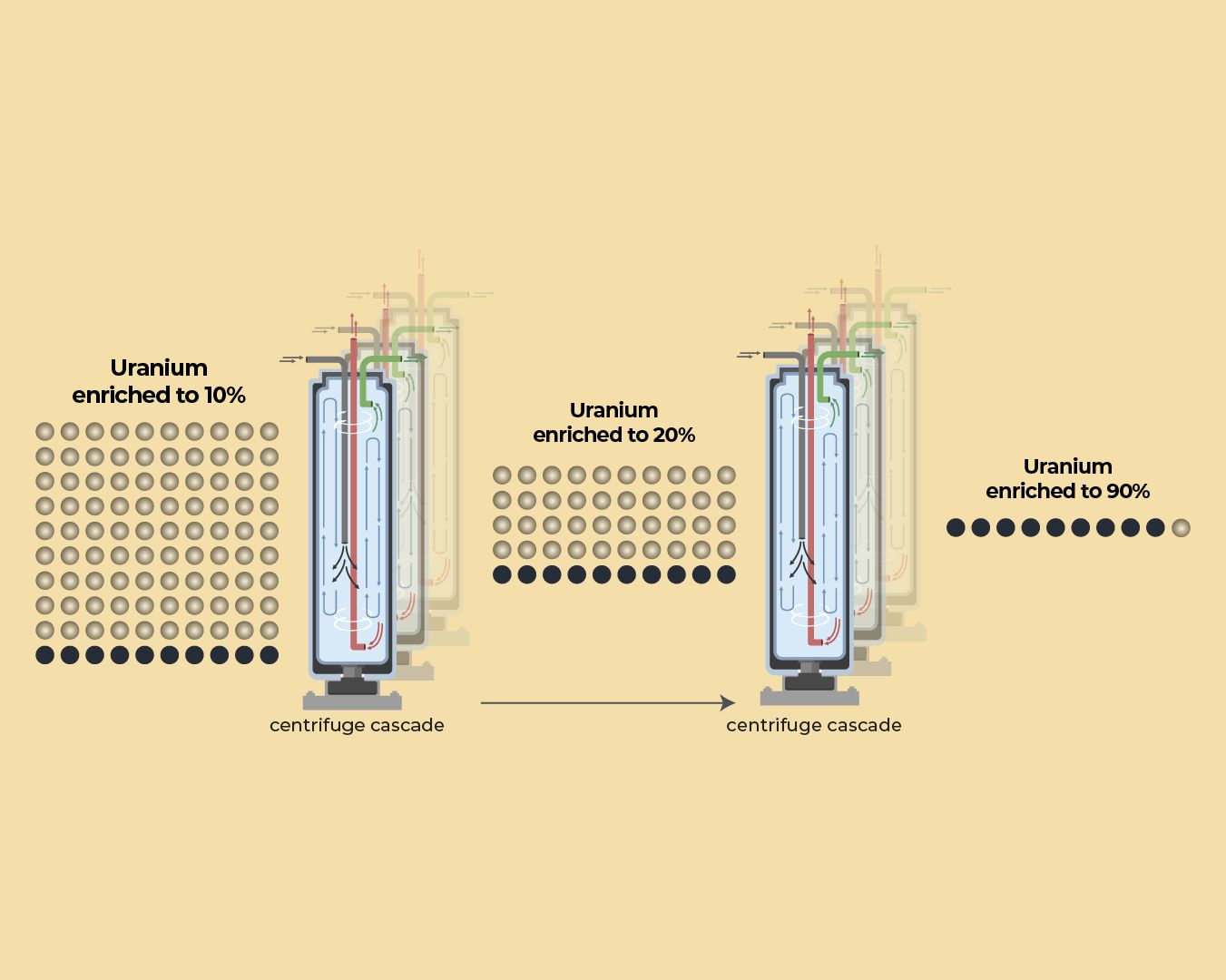
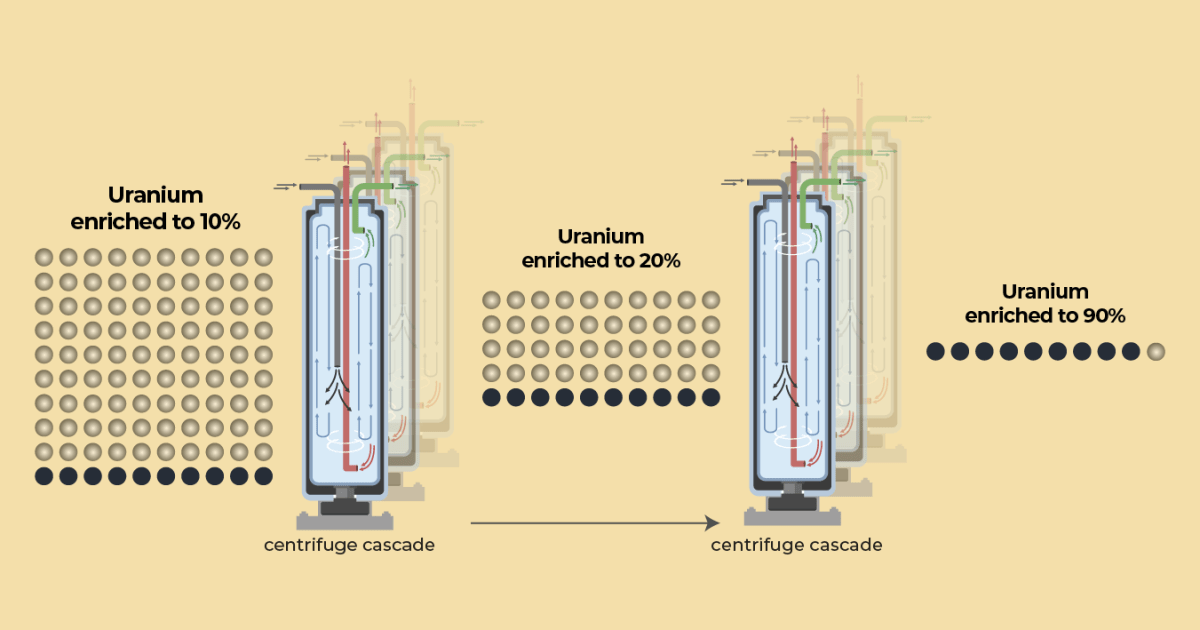
To enrich uranium, it must first be converted into a gas, known as uranium hexafluoride (UF₆). This gas is fed into a series of fast-spinning cylinders called centrifuges. These cylinders spin at extremely high speeds (often more than 1,000 revolutions per second). The spinning force pushes the heavier U-238 to the outer walls, while the lighter U-235 stays in the centre and is collected.

A single centrifuge provides only a tiny amount of separation. To reach higher concentrations – or “enrichment” – the process is repeated through a series of centrifuges, called a cascade, until the desired concentration of U-235 is achieved.

The higher the U‑235 percentage, the more highly enriched the uranium is.

Small amounts (3-5 percent) are enough to fuel nuclear power reactors, while weapons require much higher enrichment levels (about 90 percent).

The International Atomic Energy Agency (IAEA) considers anything below 20 percent to be low-enriched uranium (LEU), while anything above 20 percent is considered highly-enriched uranium (HEU).

Low enriched – less than 20 percent

Highly enriched – More than 20 percent

Depleted uranium, which contains less than 0.3 percent U‑235, is the leftover product after enrichment. It can be used for radiation shielding or as projectiles in armour‑piercing weapons.

The effort it takes to enrich uranium is not linear, meaning it is much more difficult to go from 0.7 percent natural uranium to 20 percent LEU than it is to go from 20 percent to 90 percent HEU. Once uranium reaches 60 percent enrichment, it becomes much quicker to reach 90 percent weapons grade.

The effort it takes to enrich uranium is measured in separative work units (SWU).

According to the IAEA, Iran is believed to have about 440kg (970lbs) of uranium enriched to 60 percent – enough to theoretically build 10 or 11 low-technology atomic bombs if refined to 90 percent.

Ted Postol, professor emeritus of science, technology and international security at the Massachusetts Institute of Technology (MIT), told Al Jazeera that before the US attack on Iran’s nuclear facility at Fordow, the country had at least 10 cascades of 174 IR-6 centrifuges in operation – meaning 1,740 IR-6 centrifuges.

The IR-6 is one of Iran’s most advanced centrifuge models. The country also has tens of thousands of older centrifuges.

Little is known about the conditions of these centrifuges or the stocks of uranium hexafluoride, which are still believed to be buried underground.

Postol has calculated that Iran’s cascade of centrifuges could produce 900 to 1,000 SWUs annually.

“Getting from natural uranium to 60 percent enrichment, which Iran has already achieved, takes roughly five years, and about 5,000 SWUs using Iran’s cascades.”

“If I want to go from 60 to 90 percent, I only need 500 SWUs. So, instead of five years, [by] starting with the 60 percent here, this might take me four or five weeks. Because I am already very enriched,” Postol said.

Using an analogy of a clock, Postol explained: “Let’s say it takes seven minutes to get 33 percent enrichment, and then eight minutes to get to 50 percent enrichment. It only takes me one minute to get to total [90 percent] enrichment.”

Postol said Iran’s stockpile is held underground, meaning a military strike would not necessarily eliminate the nuclear threat.

A single centrifuge cascade capable of enriching weapons-grade uranium could take up “no more floor space than a studio apartment, making it easily hidden in a small laboratory”, he said, estimating the area at 60sq metres (600sq feet).

“A single Prius Compact Hybrid car can produce enough electric power to run four or more of these cascades at a time,” Postol added, meaning “Iran can covertly convert its 60 percent uranium into weapons-grade uranium metal”.

“What they have done is put themselves in a position where anybody who thinks about attacking them with nuclear weapons has to know that they could be sitting in those tunnels after such an attack, refining [and] enriching the final step they need to build atomic weapons and converting it to metal, and building a nuclear weapon, and that they have the means to deliver it,” Postol said.

“They would have all of the technical equipment they need to build the atomic weapons. And they have the missiles, which are also in the tunnels and can be manufactured in addition to what they already have. And the atomic weapon would not need to be tested, because uranium weapons do not need to be tested before they’re used.”

The Treaty on the Non-Proliferation of Nuclear Weapons (NPT), established in 1968, is a landmark international agreement aimed at preventing the spread of nuclear weapons and promoting peaceful uses of nuclear energy. Iran is a signatory to this pact.

The treaty supports the right of all signatories to access nuclear technology and enrich uranium for peaceful purposes, including energy, medical or industrial purposes, with precise safeguards to ensure it is not diverted to make weapons.

Under the NPT, nuclear-weapon states agree not to transfer nuclear weapons or assist non-nuclear-weapon states in developing them. Non-nuclear-weapon states also agree not to seek or acquire nuclear weapons.

Despite this, most nuclear powers are currently modernising their arsenals rather than dismantling them.

Most of the countries are signatories, except five: India, Pakistan, Israel, South Sudan and North Korea.

In 2015, under the Obama administration, Iran struck a deal with six world powers — China, France, Germany, Russia, the United Kingdom and the US — plus the European Union, known as the JCPOA.

Under the pact, Tehran agreed to scale down its nuclear programme, capping enrichment to 3.67 percent, in exchange for relief from sanctions.

“The Iranians agreed to it, and they were following the treaty. There was no problem with the treaty at all, absolutely no problem,” Postol said.

“They were allowed to have 6,000 centrifuges, which, if they had natural uranium, they could probably build a bomb within a year if they were secretly using these centrifuges, but that was all under inspection. They were just simply going to enrich to 3.67 percent, which is for a power reactor. They’re allowed to do that by the Non-Proliferation Treaty.”

But in 2018, Trump pulled out of the deal, calling it “one-sided” and reimposing sanctions on Iran. Iran responded by eventually resuming enrichment at Fordow.

After the US killed Iran’s General Qassem Soleimani in January 2020, Tehran stated it would no longer follow the set uranium enrichment limits.

Former President Joe Biden made attempts to revive the deal, but it never came to fruition due to disagreements over whether sanctions should be lifted first or Iran should rejoin the JCPOA first.

Trump has repeatedly said Iran should not have the ability to produce nuclear weapons. It has been one of Washington’s red lines during talks with Iranian officials over the past year, and was also the central justification that Washington used when it bombed Iranian nuclear facilities during the 12-day US-Israel war on Iran last year.

In the current negotiations, Iran has said it is willing to “downblend” its 60 percent enriched uranium to about 20 percent – the threshold for low-enriched uranium. The process of downblending involves mixing stocks with depleted uranium to achieve a lower percentage of enriched U-235 overall.

“From the point of view of showing goodwill, I think it’s good, it shows that the Iranians are thinking of ways to address what the Americans claim are their concerns,” Postol said.

Nine countries possessed roughly 12,187 nuclear warheads as of early 2026, according to the Federation of American Scientists. Approximately two-thirds are owned by two nations – Russia (4,400) and the US (3,700), excluding their retired nuclear arsenals.

Some 9,745 of the total existing nuclear weapons are military stockpiles for missiles, submarines and aircraft. The rest have been retired. Of the military stockpile, 3,912 are currently deployed on missiles or at bomber bases, according to the Federation of American Scientists. Of these, some 2,100 are on US, Russian, British and French warheads, ready for use at short notice.

While Russia and the US have dismantled thousands of warheads, several countries are thought to be increasing their stockpiles, notably China.

The only country to have voluntarily relinquished nuclear weapons is South Africa. In 1989, the government halted its nuclear weapons programme and began dismantling its six nuclear weapons the following year.

Israel is believed to possess nuclear weapons, with a stockpile of at least 90. It has consistently neither confirmed nor denied this, and despite numerous treaties, it faces little international pressure for transparency.