Press
Beyond the desecrated statue
Images
1 / 4

2 / 4

3 / 4

4 / 4
The destruction of a statue of Jesus by an Israeli soldier in Lebanon is disturbing, but Israel’s genocide in Gaza demands far greater outrage.

A Palestinian pastor and theologian.

Save

Share

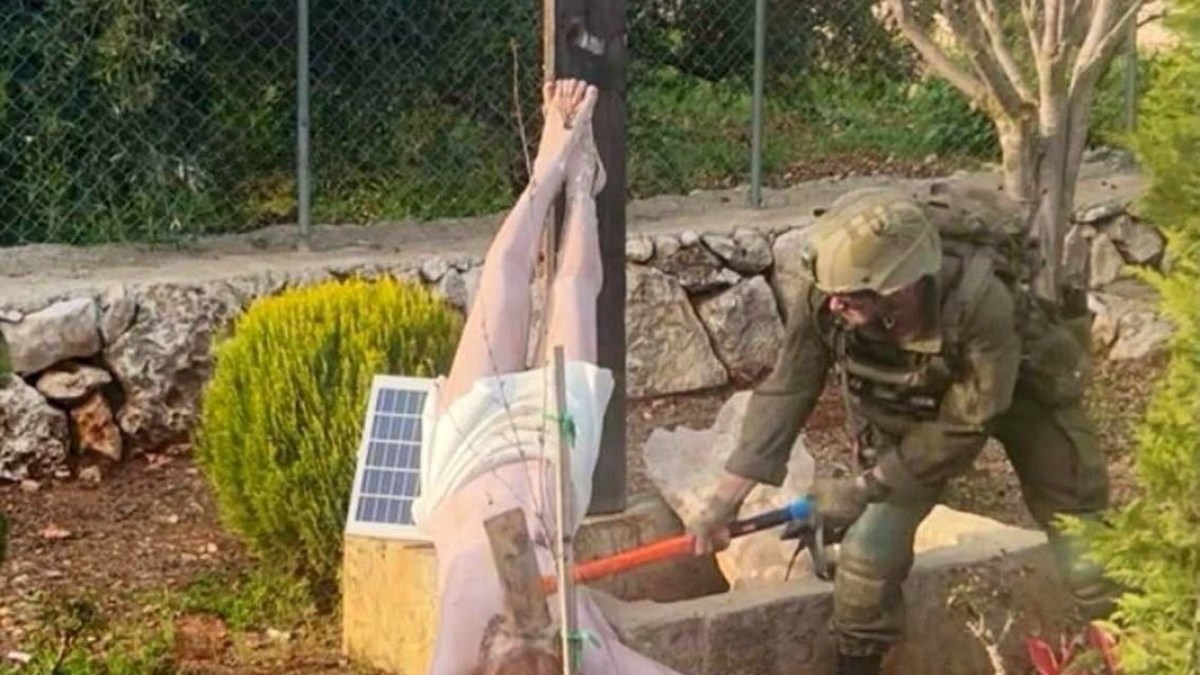
Many Christians felt offended after a video circulated on social media showing an Israeli soldier in southern Lebanon knocking down a statue of Jesus, decapitating it and striking its head as it lay on the ground.

The act is offensive and painful, particularly for Christians, for whom such an image is not only disrespectful but also a desecration. Israeli officials have dismissed the incident as an isolated act. But this raises a deeper question: What kind of culture produces such a moment? What kind of religious, political or ideological formation shapes a soldier who carries out such an act and records it?

To treat this as an anomaly is to miss its significance. This must be understood within a broader environment where enmity towards the “other” is cultivated and religious supremacy is normalised. The repeated harassment of Christian clergy in Jerusalem over the years, alongside a culture of impunity in which even acts like spitting at Christians have at times been tolerated, points to a deeper problem.

This moment gestures towards a wider pattern: The steady radicalisation of discourse and practice within Israeli society and its institutions. At the same time, it must be said clearly: This does not reflect all Jews or the Jewish faith. Many Jewish voices have long stood for justice, dignity and genuine coexistence.

Still, such incidents stand in stark tension with the long-promoted image of the Israeli military as “the most moral army in the world”, a claim that many Palestinians have always experienced as deeply offensive, as it dismisses and minimises their lived reality. Numerous documented instances, from soldiers ransacking homes, mocking civilians and destroying property, to the abuse and rape of Palestinian prisoners, further expose the gap between this image and reality. For years, Israeli soldiers have committed these acts and killed Palestinian civilians without any accountability.

This is why focusing only on this image risks a serious moral misplacement.

The real outrage should not begin, or end, with the destruction of a religious statue, however offensive that act may be. To centre our response there is to narrow the scope of what should truly trouble us.

Where is the sustained outrage when civilians are targeted? When neighbourhoods are reduced to rubble? When families are buried beneath debris, and displacement becomes permanent? A genocide has taken place. This is where the real outrage belongs.

The devastation in Gaza, alongside repeated patterns in Lebanon, has already shattered any serious claim that human rights or even the rules of war are being respected. The scale of destruction, the targeting of civilian life and the normalisation of collective punishment reveal that this is not exceptional but consistent. The video is unsettling precisely because it reflects a broader reality.

For faith leaders especially, the distinction is crucial. The desecration of religious symbols is deeply troubling, but it cannot eclipse the far greater moral catastrophe: The assault on human life. The destruction of a statue is symbolic violence; the destruction of human lives is the thing we must be most outraged by.

War unleashes brutality. That is precisely why international law exists, and why accountability must be demanded. When violations become routine rather than exceptional, we are no longer dealing with isolated acts, but with a pattern that demands urgent scrutiny.

As faith leaders, this is precisely why we must demand accountability for war crimes. If our faith is truly to mean anything, then we must recognise that it is not only desecrated when statues are destroyed, but when children are bombed, communities displaced and entire neighbourhoods flattened, often without accountability and sometimes even in the name of God.

Outrage, if it is to be meaningful, must be rightly ordered. It must be directed not only at symbolic offences, but at the systematic assault on human life.

The views expressed in this article are the author’s own and do not necessarily reflect Al Jazeera’s editorial stance.