Press
UK unemployment rate drops unexpectedly
Images

1 / 9

2 / 9

3 / 9
4 / 9

5 / 9

6 / 9

7 / 9

8 / 9

9 / 9
The UK's unemployment rate has fallen unexpectedly but wages are growing at their slowest pace for more than five years, the latest official figures show.

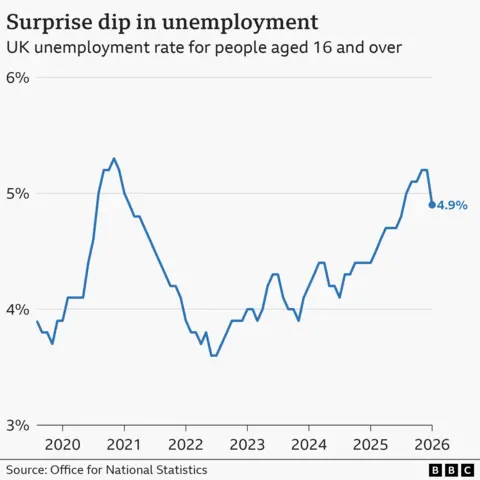
Unemployment fell to 4.9% in the three months to February, despite predictions it would remain unchanged at 5.2%.

However, the fall appears to reflect a slight rise in the number of people no longer looking for work, largely among students, who are not included in the unemployment figures.

The numbers from the Office for National Statistics (ONS) also show wages rose at an annual pace of 3.6% between December and February, the weakest rate since late 2020. Despite the slowdown, pay is still rising faster than inflation.

Liz McKeown, director of economic statistics at the Office for National Statistics (ONS) figures, said: "Alongside falling unemployment, the number of people not actively seeking work increased, with data suggesting fewer students seeking work alongside their studies."

The inactivity rate – which measures the proportion of people unemployed but not looking for work – was 21% in the December to February period, up from 20.7%.

Most of the data released by the ONS was gathered before the outbreak of the US-Israeli war with Iran, which has led to a surge in energy prices.

If these energy prices remain high, economists have warned this could affect the jobs market in coming months.

The ONS said early estimates suggest the number of workers in payrolled employment slipped by 11,000 in March, the first month of the Iran war.

The figures also showed the number of job vacancies fell to their lowest level in almost five years, dropping to 711,000 for the January to March period.

Yael Selfin, chief economist at KPMG UK, said the UK's labour market "showed signs of stabilising in February, but a reversal may be on the horizon".

She added the fall in the unemployment rate was "consistent with survey evidence suggesting hiring activity was recovering before the conflict in the Middle-East".

"However, unemployment is likely to trend higher in the coming months as firms scale back on hiring in response to rising costs and weaker demand."

Luke Bartholomew, deputy chief economist at Aberdeen, said while the sharp drop in the unemployment rate was "eye catching", it largely reflected "rising inactivity rather than stronger hiring".

"Meanwhile, with cash wages continuing to moderate and inflation set to increase sharply in the coming months, it is likely households are about to experience another period of negative real wage growth, which will weigh further on growth."

Last week, the International Monetary Fund (IMF) predicted that the energy shock from the conflict would hit the UK the hardest of the world's advanced economies.

As a result, the IMF cut its estimate for UK growth this year to 0.8%, from the 1.3% prediction made in January before hostilities began.

Forecasters have noted that as the UK is a net importer of energy, it is particularly sensitive to rapid rises in energy prices.

Official data released last week showed the UK's economy grew by a faster-than-expected 0.5% in February, indicating growth had been picking up ahead of the conflict.

While the UK unemployment rate stands at 4.9%, increasing numbers of those in work have more than one job.

The conflict in the Middle East has increased pressure on the cost of petrol, household energy bills and even food.

The charity is promised a multi-million base budget for next year after it faced funding challenges.

Stella Black says she has applied for hundreds of jobs and received few responses.

Major lenders make rate reductions as markets take some heart from a possible truce in the Iran war.