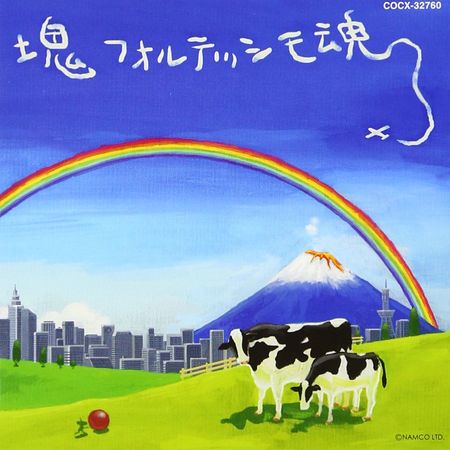
Various Artists: Katamari Fortissimo Damacy
0.0 0.0 Reader Score No score yet, be the first to add. 0.0 Label: Columbia / Bandai Namco Release Date: 2004 Wherever you’re reading this, take a second to look around you. If you…
0.0
0.0
Reader Score
No score yet, be the first to add.
0.0
Label:
Columbia / Bandai Namco
Release Date:
2004
Wherever you’re reading this, take a second to look around you. If you’re at home, you might notice, I don’t know, your stove. You might see your cat, or your stereo, or your rug. If you’re out and about, you might see the leaves on the ground, the cars on the street, the people around you. Take note of it all—it’s life. Our lives are made up of a million different objects and beings, all with different purposes, but all here at once—separated in form, united in a space we call Earth. What if all of life’s materials, trivial and essential alike, came together as one? What does everything look like, and what does it mean?
These are the far-out ideas that Namco’s 2004 cult masterpiece Katamari Damacy (“Clump Spirit” in English) dares to tackle. In Keita Takahashi’s practically buttonless PlayStation 2 game, you use only the control sticks to navigate the five-centimeter-tall royal heir known simply as the Prince around bedrooms and fields and cities. Your task is to roll up everything in your path—objects, people, animals, nature—into magical spheres called katamaris, which turn from grotesque balls of material into beautiful stars. This is all done to appease the King of All Cosmos, the Prince’s Dionysian father who talks in record scratches and once destroyed all the previous stars in the sky in a drunken rage. Pretty normal, right?
No score yet, be the first to add.
0.0
Takahashi’s crowning opus is idiosyncrasy in its truest form, a wildly original work whose programmed absurdities—like its ingeniously simple gameplay, at once domestic and outlandish graphics, and hilariously charming premise—challenge you to reconsider the deeper meaning behind life’s moving parts. It defies every convention imaginable: genre, gameplay, value, reason. There’s nothing like it, which is funny, considering it’s a game where the most familiar objects of our lives are at play—even the most humdrum, like nail clippers and sticks of gum.
A rare example of a video-game auteur, Takahashi strategically gave his close collaborator Yuu Miyake little to no direction for the soundtrack for his ludicrously imaginative game. Miyake had already built a reputation at Namco as one of its main Tekken series composers, but this outlandish project was a far cry from the flagship fighting games’ intense rock and dance soundtracks. But he and Takahashi clicked so thoroughly (a feat in itself, given Takahashi’s odd genius), that directing the score flowed naturally. “I’ve recently come to realize that having a deep understanding of the content of a project means you don’t have to worry about it too much,” he told Tone Glow.
What little there was to understand actually worked to the soundtrack’s benefit. Miyake decided that everything imaginable should soundtrack this game about everything imaginable. On a strikingly low budget, he tapped a cast of Japanese musicians both old and new to execute his vision of musical wholeness—letting them make whatever they desired, genre consistency be damned, so long as the songs evoked the Katamari essence. It was as unconventional as a video-game soundtrack had ever been, right in line with the game.
Miyake and his team would turn in the liveliest video-game soundtrack to date. Featuring a hybrid of live instrumentation and digital production, Katamari Fortissimo Damacy gathered kitschy sounds of the past and modish styles of the present into a retro-futurist constellation sparkling with supreme musicianship, deep affection, and cathartic pleasure. Gaming’s most idiosyncratic title has its most idiosyncratic soundtrack, an achievement for the medium that remains unrivaled. Its songs provide the heart and soul of a creation easily dismissed as merely wacky fun, transmuting the game’s surface-level wit into a sincere appreciation for the absurd nature of life on Earth. More than its gameplay or premise could on their own, it compels you to laugh, cry, and smile about how wild and wonderful our lives and our world really are.
If concepts like kitsch and retro-futurism sound familiar in a Japanese context, it’s because the soundtrack’s emotional payoff is heavily indebted to Shibuya-kei: a subcultural movement in 1990s Tokyo whose musicians dug up records of old from around the globe and fused their sounds together first through hybrid revivalism, and later, an incorporation of digital sounds. The style deployed a postmodern toolkit—bricolage, pastiche—in the creation of a third, once-undefined space in Japanese music at large: too unwieldy to be mainstream, too joyous and poppy to be underground, just right as the trendy, retro-futurist alternative to the binary. Artists rolled up music as forgotten and/or passé as swing, mambo, and ’60s commercial pop into a vital contemporary sound where bygone styles lived harmoniously with new expressions like dance, hip-hop, and electronica.
Shibuya-kei was a lot like the musical image of a katamari—a unifying entity built from parts both important and taken for granted—which made Katamari Damacy the perfect first option to fully adopt the style after previous soundtracks had vaguely flirted with it. Though Miyake has never explicitly acknowledged Shibuya-kei’s influence, it’s remarkable how closely the soundtrack captures its essence. Asuka Sakai’s “A Crimson Rose and Gin Tonic” is a swing cut seemingly plucked right out of American Prohibition, but with docile, high-pitched Japanese vocals and flute solos. Miyake’s hyper-detailed “Angel Flavor’s Present” is kin to late-’90s Cornelius. Mambo (“Katamari Mambo”), samba (“Katamaritaino”) and glitchy house (“Wanda Wanda”) are treated as a single entity separated by time and place, but bound together by spirit. And if that weren’t convincing enough, try Charlie Kosei’s “Que Sera Sera,” which features a full-on Sinatra impression sung and played with even more conviction than the die-hard North Jersey karaoke regular at your favorite red-sauce restaurant.
Shibuya-kei might’ve made perfect sense for Katamari Damacy’s premise, but it meant something entirely different in the video-game medium. Miyake wasn’t concerned with embodying the art of the cool independent internationalist; he was directing a video-game soundtrack for a major publisher (and in any case, Shibuya-kei’s cultural heyday had passed by 2004). Out of its prime and element, the style took on new, postmodernist purposes; the soundtrack’s retro-futurism was spurred at least in part by Miyake’s attitudes surrounding the then-current state of video-game music—specifically the idea that new soundtracks couldn’t be as memorable as old-school games tethered to 8- and 16-bit sound palettes. “In all honesty, that’s something that kind of pisses me off,” he told an interviewer. “I experimented in order to figure out whose responsibility [making memorable video-game music] is.”
The soundtrack challenges short-sighted ideas about game music with retro-futurist creations both cheeky and grand. Nestled into the dizzyingly modern frenzy of “You Are Smart” is a sudden barrage of chiptune reminiscent of Namco’s 8-bit arcade games; the way it brazenly obscures the mix, it’s seemingly there just to poke fun at those archaic noises. The more grandiose “Lonely Rolling Star” is a J-pop song built from those same bleeps and bloops. But the track takes those chintzy sounds of old and proves that they can be even more resonant when assembled into something massive and state-of-the-art—in this case, an electrifying pop anthem that tops its cutesy verses and maudlin bridge with a heartfelt singalong hook for the ages.
The essence of Miyake’s retro-futurist mindset is right there in the first thing you hear when starting up the game, and subsequently, the most common theme you hear throughout your adventure: the impossibly catchy refrain known as “Katamari Nah-Nah.” So video-game music has to be tethered to chiptune to be memorable? Well, what if a game stretched a melody right out of Shibuya-kei’s penchant for ’60s sunshine pop all across its genre-hurdling soundtrack? Miyake’s phrase lasts from the game’s psyched-out ’70s TV show-esque main theme, “Katamari on the Rocks,” to the spaced-out acoustic/digital hybrid instrumentation of “Angel Flavor’s Present,” to “Lonely Rolling Star”’s saccharine outro, and in nearly every Katamari game thereafter. It’s one of the most instantly recognizable leitmotifs in video-game history—hearing those nah-nah-nahs conjures a certain tongue-tied tenor only this series could evoke.
Katamari Damacy’s soundtrack is evidence that nonsense can be worth a thousand words. The main leitmotif is just a portion of the music’s most consistent trait: its ever-present vocables, a signature of classic Shibuya-kei. The scat singing on “A Crimson Rose” and “Que Sera Sera” harnesses the songs’ unwavering glee. “Wanda Wanda” uses its gibberish title as a melodic refrain inside a raving house arrangement, acting as the beating heart of its frenzied fun. And the be-dahs and dee-dops all over “Katamari Mambo”’s bridge sell its Japan-does-Cuba pastiche before sputtering into a muted trumpet solo.
Those eccentric vocalizations, in fact, are the strongest facet of the soundtrack’s most breathtaking, dynamic compositions. “The Moon and the Prince”’s pop-rap hybrid has groovy record scratches, bit-crushed guitars and pianos, and slick verses courtesy of famed Japanese vocalist Kenji Niinuma—but what would it be without the glorious ooo-ooo–ooo-ooooo vocal line snuggled into the hook and outro? The seductive sax, dramatic violin, and delicate flute on the fast-paced samba track “Katamaritaino” make for the soundtrack’s most heavenly experience, but even with all that going on, the most divine thing about it is singer Yui Asaka’s yaa-yeah-ya-yeahhh chorus.
The actual lyrics channel the abstract beauty of Katamari Damacy’s titular “clump spirit” more directly, and with more thematic precision than any gaming soundtrack before. Its vocal tracks verbalize central concepts—everyday objects, constellations, rolled-up unity by way of giant balls—as various allegories, turning what might outwardly seem like a comedic experience unexpectedly profound. A game as loony as this just shouldn’t be able to convey themes as weighty as romance, nostalgia, and philosophy. But it’s really that deep; without its music, Katamari Damacy’s exhaustive subtext might never come through.
Songs like “Katamaritaino” and “Que Sera Sera” treat the outlandish idea of rolling into a unified star with another lover as the most genuinely affectionate thing in the world. The former conveys celestial amity with glowing imagery (“Rolling box/While we roll around, I need you to tell me… harden yourself… Falling star”) while the latter gives it to us simple and straight, like any great Sinatra track would (“I wanna wad you up into my life/Let’s roll up to be a single star in the sky”). “Cherry Blossom Color Season,” one of the final full tracks, showcases Miyake’s love for seishun, the Japanese term for bittersweet memories of youth. Its verses—sung by an adorable children’s choir—feature nostalgic mantras on the way rolling a katamari makes you “feel joy from the small things,” like airplanes in the sky, city streets, and the colors and feelings of different seasons, as though this sort of pathos hasn’t already set in at this point in the game.
Even though the lyrics are inaccessible to anyone who doesn’t speak Japanese, you feel the seishun of “Cherry Blossom Color Season” through its resounding arrangement; youthful nostalgia is embedded in its Bacharach-esque strings, softly plucked guitar line, and heartwrenchingly wistful la-la-la chorus courtesy of the kids. Hideki Tobeta’s “Katamari Stars” plays in a menu gallery where you simply gaze at the stars you’ve created throughout your rolling adventure, but its sweeping strings and tender recorder evoke the feelings instilled by stargazing without any need for words. Its gleaming arrangement compels us to reflect on the idea that we—and all the objects around us—are part of something bigger, bound together in a harmonious spirit.
How fitting is it then, that the centerpiece track functions as a katamari of Katamari Damacy—a unifying being made up of all of the game’s disparate, dynamic emotions that appropriately scores its anomalous home menu. Yuri Misumi’s “A Wonderful Star’s Walk Is Wonderful” builds from featherlight acoustic guitar passages and soft vocal bahs at its outset, to whimpering violins and synths as the track ramps up in both pace and emotion. What starts as sparse, folky electronica evolves measure by measure into a full-on marching tune, marked by a harmonious mix of zany horns and squeaking digital synths. At once silly, sentimental, and sublime, it channels the sensations of life itself—this wild and wonderful thing that Katamari Damacy lets us dissect, reconstruct, and appreciate.
Writing on the soundtrack’s 20th anniversary, Patrick St. Michel called the soundtrack the “last hurrah” for Shibuya-kei. But really, it was the catalyst for a new beginning. The Katamari series only parlayed its mastery of the style into different incarnations game after game. We Love Katamari, the immediate follow-up, had sprawling, multi-part Shibuya epics; Beautiful Katamari pushed the style even further into modern dance; and the globetrotting, time-traveling Once Upon a Katamari showcased an abundance of contemporary styles fused with traditional music. Shibuya-kei could’ve died as an of-its-time cultural relic, but it lives, breathes, and grows with the series shaped around it.
Gaming is a medium both physically and spiritually stimulating, where through play, we unearth meaning from even the most outrageous premises. Katamari Damacy’s soundtrack illustrates how music can, and should, be an indispensable aspect of this mediated experience. What Miyake considered a lost art of pairing gameplay and music found renewal in his greatest work, a score that expresses the spirit that you, the player, create by rolling up the entire world into a single entity. It’s something only a video game could make possible.
“Takahashi and I now understand why athletes cry after winning a big game,” Miyake once said in response to praise for his direction. That’s just the thing about Katamari Damacy’s poetics of unity: A katamari’s purpose—rolling up everything into the ultimate form of wholeness—is as bizarre as it is beautiful, just like life itself. What we do in a lifetime is what the soundtrack wads up and sets to music. We sing, we dance, we cry, and we love—it never really makes sense, but all together, it couldn’t be more lovely. A katamari grants a magnificent, inspiring form to this innate feeling; its musical manifestation does so just as much through sound. In gaming as in life, here’s to rolling along as long as we can.
0.0
0.0
Images from the story

End of article